Opening up new markets in machinery — but how?
Market access without upfront investment
Market entry in machinery and plant engineering follows a sequence that costs years and ties up capital before anything comes back. Why that sequence can be reversed, how much less headcount it takes, and where the method reaches its limit.
Order intake shows no momentum. The VDMA has cut its production forecast for 2026 to zero growth [1]. One company after another is running into trouble.
The explanation is quickly found in external circumstances: tariffs, trade barriers, geopolitics, energy costs, regulation, bureaucracy, a weak economy. All of it carries part of the weight, but not all of it. The other part is the one a company holds in its own hands.
Innovation in machinery is technology-driven. In machines, controls, processes and precision the industry works at world level, and that is where development and investment go. In sales, in marketing, in automating a company's own commercial workflows and in adopting new tools, the picture is different. Only 11 percent of industrial companies count as leaders there, 48 percent as laggards [17].
For many machinery and plant manufacturers the same question follows: we need to open up new markets. But how, without tying up eight-figure sums first and waiting three years to find out whether the decision was right?
This is not a question about better market studies. It is a question about sequence.
Three starting positions
In practice the question reaches me in three forms. They differ in the pressure the answer has to stand up to.
A private equity owner wants the top line to grow fast. The exit horizon governs everything. A market entry that only pays off in year four is worthless, even if it is commercially sound. What is needed is order intake within the valuation period, and with it the proof that it is repeatable. A buyer pays for a demonstrated mechanism, not for isolated wins.
A company has stalled and wants to grow again. The reflex is to declare the home market exhausted and go abroad. Often the premise does not hold. An analysis of 448 companies found an average of 22 percent of potential target accounts recorded in the CRM [15]; TAM analyses arrive at more than 80 percent of the target group missing [16]. A market you know only in part is functionally an unopened market: it demands the same work, only without founding a subsidiary. Before a foreign structure is built, it is worth checking whether the home market is genuinely exhausted or merely half-worked. What that adds up to I have worked through in Why your sales organisation is sleeping through the future (in German).
Order intake is falling and the situation is already tight. There are no funds for an upfront investment and no time for a three-year build. Order intake has to come before the investment, because otherwise there will not be one.
One qualification belongs at the beginning of this third case rather than the end: market access does not replace a cost structure. If the margin does not carry at the core, additional volume sharpens the problem instead of solving it. Two of the three cases in the next section failed on exactly that, not on missing market access. Then a different piece of work comes first.
In all three positions the practised route fails at the same point.
What is actually happening in 2026
Three insolvencies from this year, and three different causes.
Engmatec in Radolfzell on Lake Constance builds assembly and automation systems, founded in 1994. In March the company entered self-administration, no investor was found despite the process, and production ends in October. 150 jobs. Alongside the economy, the administration named intensified price competition from Asia as the cause [3].
SMB International in Quickborn supplies warehouse, filling and conveyor systems and employed around 160 people. The trigger for self-administration in July was three large projects that had become unprofitable [8].
Manroland Sheetfed in Offenbach builds printing presses. After protective shield proceedings in February, manufacturing ended at the end of May; at least 660 of around 750 employees lost their jobs. Overcapacity in the market, insufficient utilisation and a loss of more than €40m in 2025 alone were named [5].
Price competition, concentration risk, structural market decline. None of these causes is primarily political. Whoever books all three under "the economy" draws the wrong lesson and reaches for the wrong remedy.
Because at the same time order intake is growing. In the first half of 2026 it was 5 percent above the previous year in real terms. Broken down, it makes an unambiguous statement: domestic minus 2 percent, foreign plus 9 percent, euro countries minus 8 percent, non-euro countries plus 16 percent. In June the picture sharpened further, with plus 54 percent from non-euro countries against minus 17 percent from the eurozone [2].
Growth is therefore coming from the markets that are not the familiar European home ground.
The VDMA itself calls this a positive snapshot, shaped by special effects in large-plant business, and explicitly not a turning point. That does not change the direction, but it does change the confidence with which it can be extrapolated.
The real question is not what a market entry costs. It is how long the money sits at risk before the market answers for the first time.
Why the conventional route prevents exactly that
The practised sequence is familiar. First a market assessment, usually bought in. Then the decision on the setup: own subsidiary, agency, distributor network. Then staff, premises, spare parts inventory, service engineers. And eventually, after all of it, the first order.
There is a design fault in this sequence: it demands the full investment before the first assumption has been tested.
As long as markets changed slowly, that was defensible. Today it ties up capital in a phase in which nobody can say whether the market carries. Whoever gets it wrong has to dismantle: notice periods, lease agreements, reputational damage in the market.
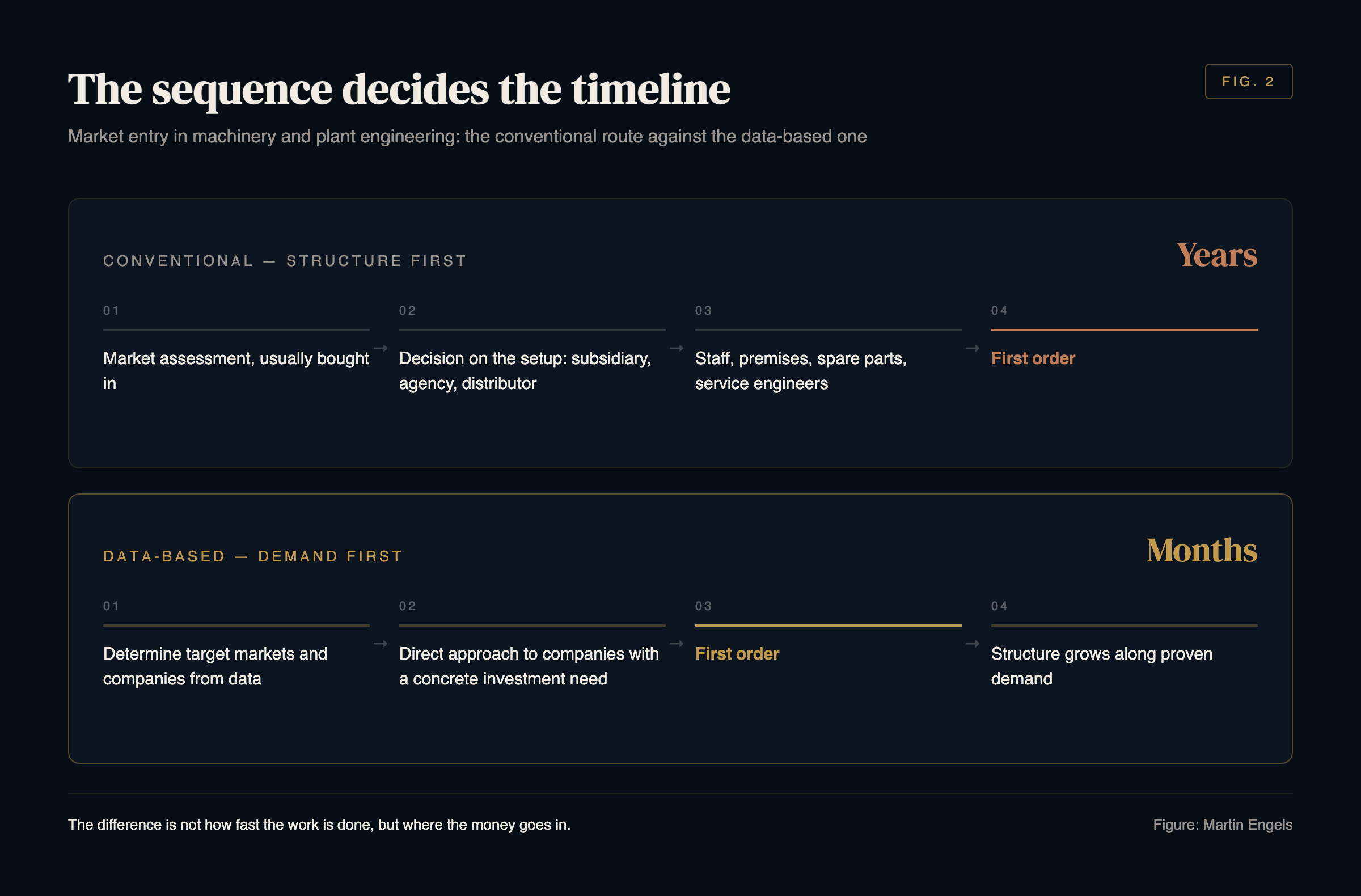
The reversal is easy to describe: determine target markets and target companies from data first, then approach the companies with a concrete investment need directly. Order intake arises before an organisation exists. The structure grows afterwards along proven demand, and in the places where demand has actually shown itself.
On the conventional route years pass before the first order, because the structure has to stand first. Through data-based identification and direct approach it is months. I do not want to put a finer number on it. What holds up depends on the product, the market and the starting position of the individual company.
A second difference weighs more than the timing. Whoever invests first and tests afterwards has to dismantle a wrong decision. Whoever tests first and invests afterwards corrects a hypothesis.
I have opened up markets several times, in different industries and different countries. Mostly by the conventional route, because for a long time there was no other. Recently I have taken the other one.
The comparison drawn here therefore does not come from a study, but from both experiences.
What has changed is the resolution
How a customer base used to come about is the best measure of the difference. It was the result of years of sales work: trade fairs, catalogue mailings, territory trips, referrals, card files maintained over years. Whoever took over a territory inherited a predecessor's list or started from nothing. Building a reliable base of potential customers in the CRM cost working years.
The same base can be produced today with a tool such as Gieni in a matter of days: companies with names, locations and production profiles, in the region you want, regardless of whether a field sales engineer has ever been there.
What costs time afterwards is no longer the collecting but the qualifying. Which of these companies actually fit, which may be supplied, in what order they are approached. For that I count in weeks.
So what is new is not the intention but the data. Questions that classical market research could only answer with samples and extrapolation can now be answered for individual companies: where is new capacity being built? Which installed base is due for modernisation? Which competitors are present locally, and where do gaps remain?
A market study tells you how many relevant companies a country has. Market intelligence tells you which of them are investing right now.
How this works in practice
I work with Gieni, a platform for industrial market intelligence run by Orderfox Schweiz AG in Zurich. I am an External Advisor there, so I am not writing this as a detached observer. Anyone who reads what follows critically is reading it correctly. I name the limits of the method myself in the next section, and not despite that role but because of it.
The basis is a continuously updated body of data on millions of industrial companies: their production and technology profiles, their capacities, their supply chain relationships [6]. It is used in three ways. Queries in natural language, structured research for supplier and customer discovery, and market reports generated from both. The query also runs directly inside Microsoft 365, and further CRM connections are in progress. In 2025 the platform was presented as a reference case at Microsoft Build [7].
In practice a market assessment begins by asking the question you cannot ask a market study. Not "how large is the market for machining centres in Vietnam", but: which companies in this region machine a part spectrum that matches our machine, have added capacity in recent years, and run an installed base approaching the end of its life cycle.
What comes back are not market sizes but companies by name. After the filters discussed in a moment, that becomes an approach list. And from that comes order intake, before anything exists on the ground.
The first lever sits exactly here: the investment decision moves behind the first response from the market instead of ahead of it.
The second lever: less hiring
Since March 2026 the platform goes further. Gieni ABX, developed together with Microsoft on Azure, executes entire workflows instead of proposing them: a campaign, updating the pipeline, a board briefing, booking demo appointments. The result goes to a human for approval, with configurable approval stages, escalation logic and full auditability [4].
For market entry this weighs more than faster identification. When research, first contact, content and evaluation run largely automated, it is not only the time to first order that falls, but the headcount needed to work a territory at all. The structure that eventually emerges is smaller than the one that would have been necessary for the same market ten years ago.
That changes the arithmetic in all three starting positions. For the financial investor, because growth without proportional cost build-up reaches the margin and not just the revenue line. For the stalled company, because the home market can be worked more completely without enlarging the team. And for the tight situation, because it makes the route feasible at all: where there is no money for additional posts, what matters is how much market coverage is possible without them.
Conventional field sales keeps its justification. What it needs are far better pre-qualified leads — which means lead generation is no longer its job.
That is the real division of labour, and it is regularly misunderstood. A field sales engineer in machinery is expensive because they can advise on technology, assess applications and hold a relationship over years. Occupying them with working out whom to visit was never a good use of that ability. It was simply the only option available for a long time.
Where the method breaks
Now the part platform vendors rarely write.
Accuracy cannot be quantified seriously. One figure circulates in almost every article on the subject: data providers achieve around 50 percent accuracy on average. Follow it back and one vendor cites the next, and at the end sits a secondary source with no verifiable method [9][10][11]. Figures for data decay likewise range between 22 and 70 percent a year depending on the field [9]. A comparison test across 500 records reports no accuracy figures for company data at all and, in the same breath, describes itself as an argument rather than a verdict [12]. That there is no reliable published number is the finding.
Company data is modelled, not collected. Apollo, itself one of the large providers, writes about its own category: revenue and headcount figures are modelled estimates, not verified facts, derived from web signals, job postings and financial filings rather than gathered directly [11]. That is exactly what a target company selection rests on.
Coverage is thinnest where it becomes interesting. Regional providers report consistently that the large global databases cover essentially Singapore in South-East Asia, while Indonesia, Vietnam, Malaysia, Thailand and the Philippines remain thin; in Africa coverage concentrates on a few countries [13]. These sources sell precisely this gap, so they have an interest in the statement. It is nonetheless verifiable, by anyone who looks up a handful of companies they know in those markets.
From this follows a step I build in before every market decision: run a sample from your own target profile against independent verification. Vendor accuracy claims are a starting hypothesis, not evidence [9]. Ahead of an investment decision of this size, the effort is modest.
Automation scales the same errors. An approach built on modelled company data does not become more accurate through automation, only faster. Whoever sends a thousand misdirected messages automatically burns a market more thoroughly than three field sales engineers could. The sample test therefore belongs before the first campaign.
The legal framework in Germany is also tighter than where these tools originate. Advertising by email is in principle subject to consent even in business-to-business dealings; a separate standard applies to telephone calls to companies (§ 7 UWG). Whoever automates first contact clarifies that with legal counsel in advance, not after the first warning letter.
And automation ends before the order. In machinery and plant engineering nobody buys a machine through an email sequence. It leads to the meeting. Technical clarification, application advice, acceptance and service remain human work. The headcount requirement therefore shifts rather than disappears: less in the run-up, unchanged in application and service.
And a hit can be legally worthless. 69 percent of internationally active German companies report increased trade barriers, an all-time high. 35 percent name export controls, 30 percent sanctions [14].
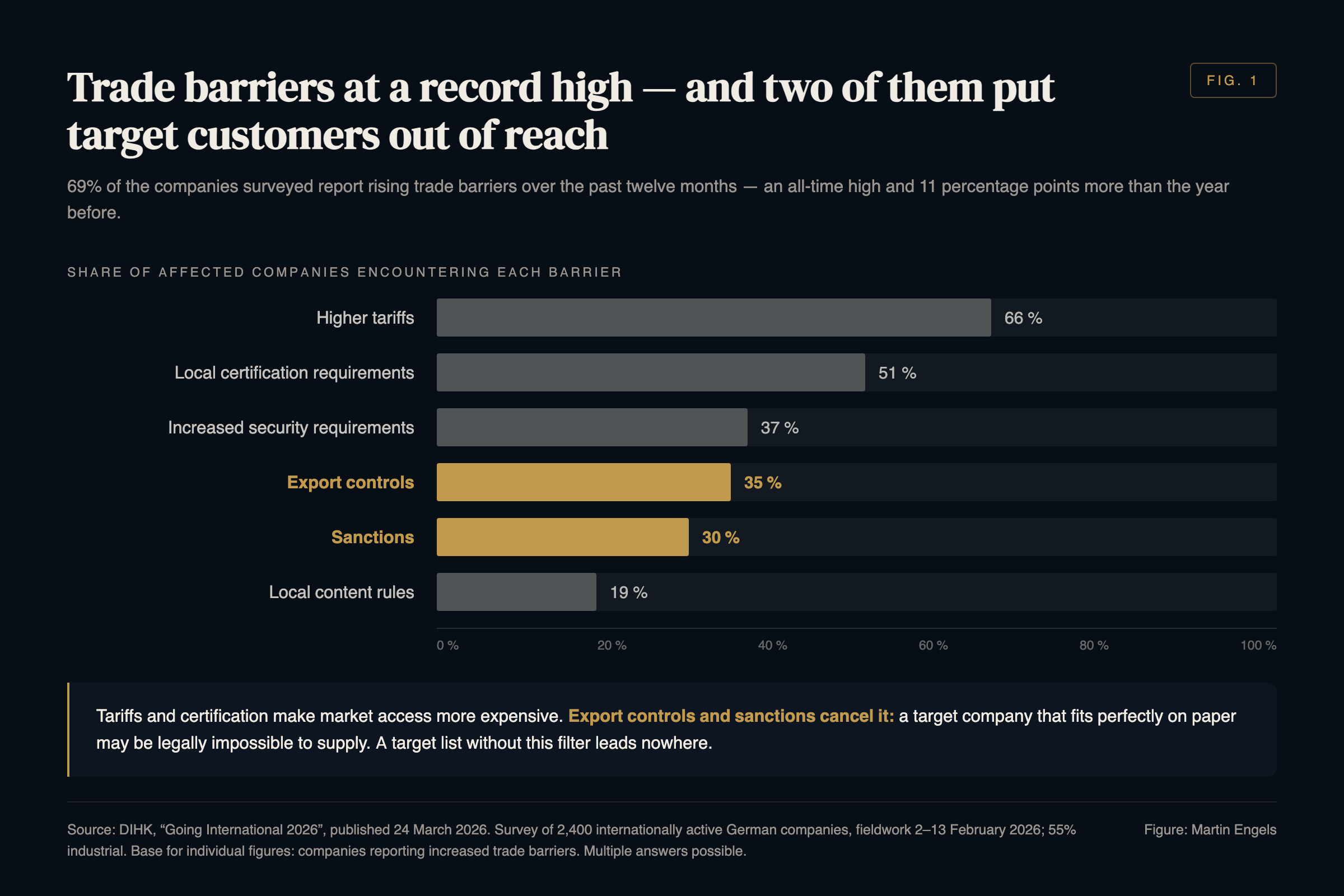
A target company that fits perfectly on paper (right industry, right capacity, demonstrated investment need) may be impossible to supply. No market intelligence checks that. It knows capacities, not control lists. Ability to supply therefore belongs as a filter before the approach, not after it.
A target list is not a result. It is a hypothesis with names, and it only becomes worth something once it has been checked whether the names hold and whether you are allowed to supply.
What therefore remains leadership work
The platform shortens identification from quarters to weeks. It does not answer what follows from it.
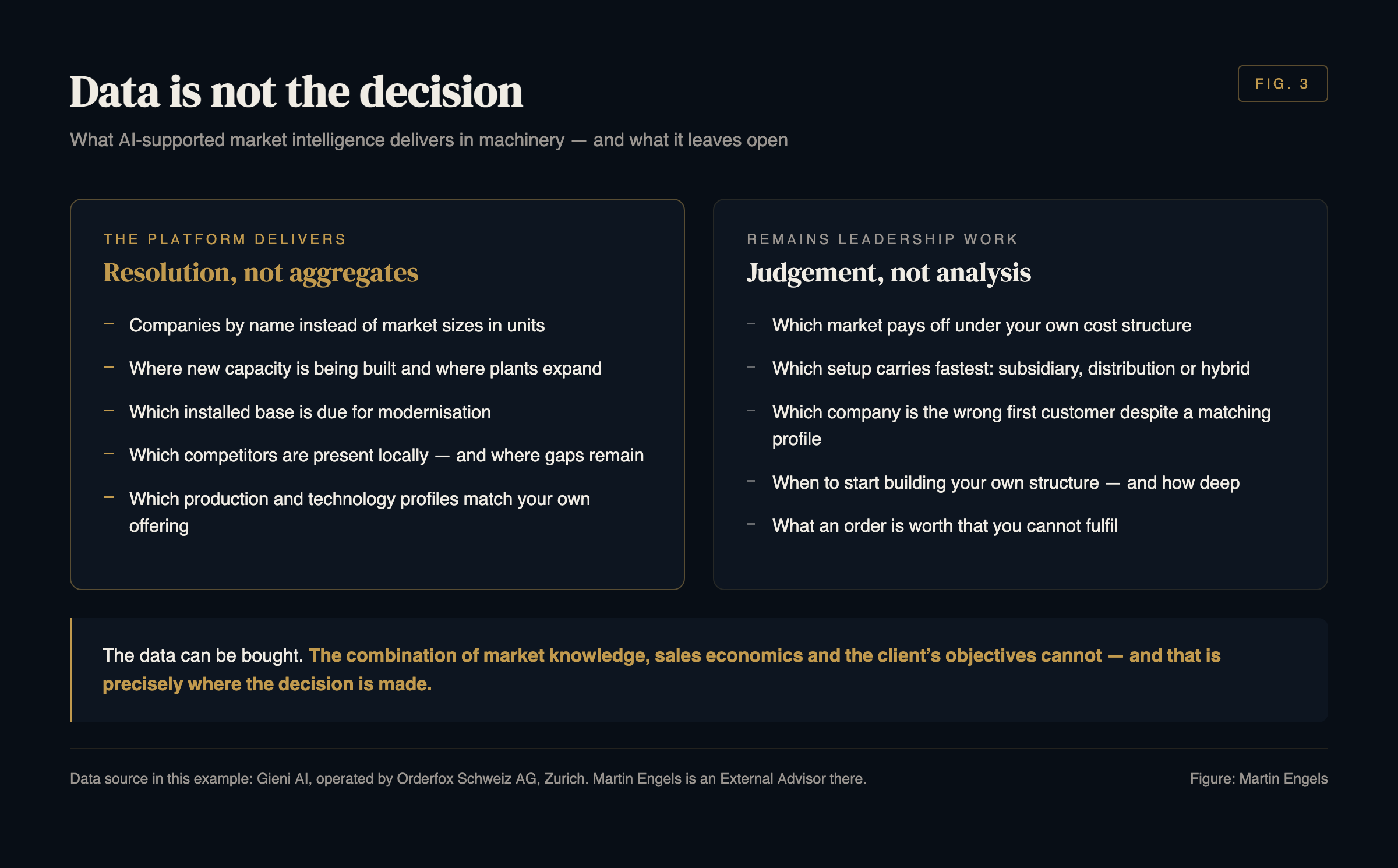
Which market pays off under your own cost structure. Which company is the wrong first customer despite a matching profile, because a failed first project closes a market for years. In what order the approach runs. When building your own structure starts, and how deep.
The setup question belongs here too. Own subsidiary, distribution or hybrid is often treated as a matter of principle; it follows a single criterion, which is time to the client's objective. A financial investor with a defined exit horizon needs a different setup from a family company thinking in generations. Completeness of structure is not a value in itself but a cost position that has to justify itself.
Part of that is planning for resistance. 42 percent of the companies with the lowest digital sales maturity report active resistance from their own sales staff [17]. Someone who has worked to a visiting routine for twenty years experiences a data-based target list first of all as a vote of no confidence. That is leadership work, not a tooling question.
The question before the investment decision
Before the conversation turns to location, legal form and staffing, a different question is worth asking:
Can we name the companies in this market that will invest in the next twelve months — by name? And are we allowed to supply them?
If either answer is no, the location question is premature. Not wrong, but premature. It answers a detail while the foundation remains untested.
Disclosure: I am an External Advisor at Orderfox / Gieni. That role is the reason I know the approach described here from practice and not only as a concept, and the reason I name its limits. It is disclosed to clients.
Sources
- VDMA: Economic development and business cycle — production forecast for 2026 cut to zero growth, domestic demand declining. → vdma.eu
- VDMA: Order intake in machinery and plant engineering, June and first half of 2026 (real, year on year); assessment by VDMA economist Anke Uhlig. → verbaende.com
- Engmatec GmbH, Radolfzell: self-administration March 2026, no investor, production ends October 2026, around 150 jobs. → t-online · SZA
- Orderfox Schweiz AG / Microsoft (March 2026): introduction of Gieni ABX (Autonomous Business Execution) on Microsoft Azure. → news.microsoft.com
- Manroland Sheetfed GmbH, Offenbach: protective shield proceedings February 2026, manufacturing ends 31 May 2026, at least 660 of around 750 employees; loss of more than €40m in 2025. → t-online
- Gieni AI, operated by Orderfox Schweiz AG, Zurich. The author is an External Advisor there. → gieni.com
- Gieni AI as a reference case at Microsoft Build 2025. → logisticsit.com
- SMB International GmbH, Quickborn: self-administration on 9 July 2026, around 160 employees; triggered by three large projects that had become unprofitable. → t-online
- Clay: "What Is B2B Data? How to Choose a Provider in 2026" — states the 50 percent field average and the 22 to 70 percent decay range without naming a study; formulates the sampling recommendation. → clay.com
- Landbase: "Firmographic Coverage Statistics" — traces the 50 percent back to SalesPlay/Markets and Markets; the original source is not verifiable from there. → landbase.com
- Apollo: "How Accurate Are Company Revenue and Employee Counts in a B2B Data Platform?" — a provider on its own category: modelled estimates rather than verified facts. → apollo.io
- Cleanlist: "Best B2B Data Providers 2026" — test across 500 records, results only for email and phone, none for company data; described by the vendor itself as "an argument rather than a verdict". → cleanlist.ai
- SyncGTM: coverage analyses for APAC and for the Middle East and Africa — regional providers with an interest in the gap described. → APAC · Middle East & Africa
- DIHK (24 March 2026): "Going International 2026 — trade barriers at a record high". Survey of 2,400 internationally active companies, fieldwork 2–13 February 2026. → dihk.de
- 6sense Research (2025): CRM coverage analysis, n=448. → 6sense.com
- DealSignal / Marketing Dive: TAM analyses. → marketingdive.com
- Accenture: "High-Voltage Digital Sales", 500 executives in industrial sales organisations. → newsroom.accenture.com
Martin Engels is an interim manager and advisor for machinery and industrial technology. 20+ years in the industry, 15+ of them at C-level with Yamazaki Mazak, DMG MORI, Seidenader and the CHIRON Group.